
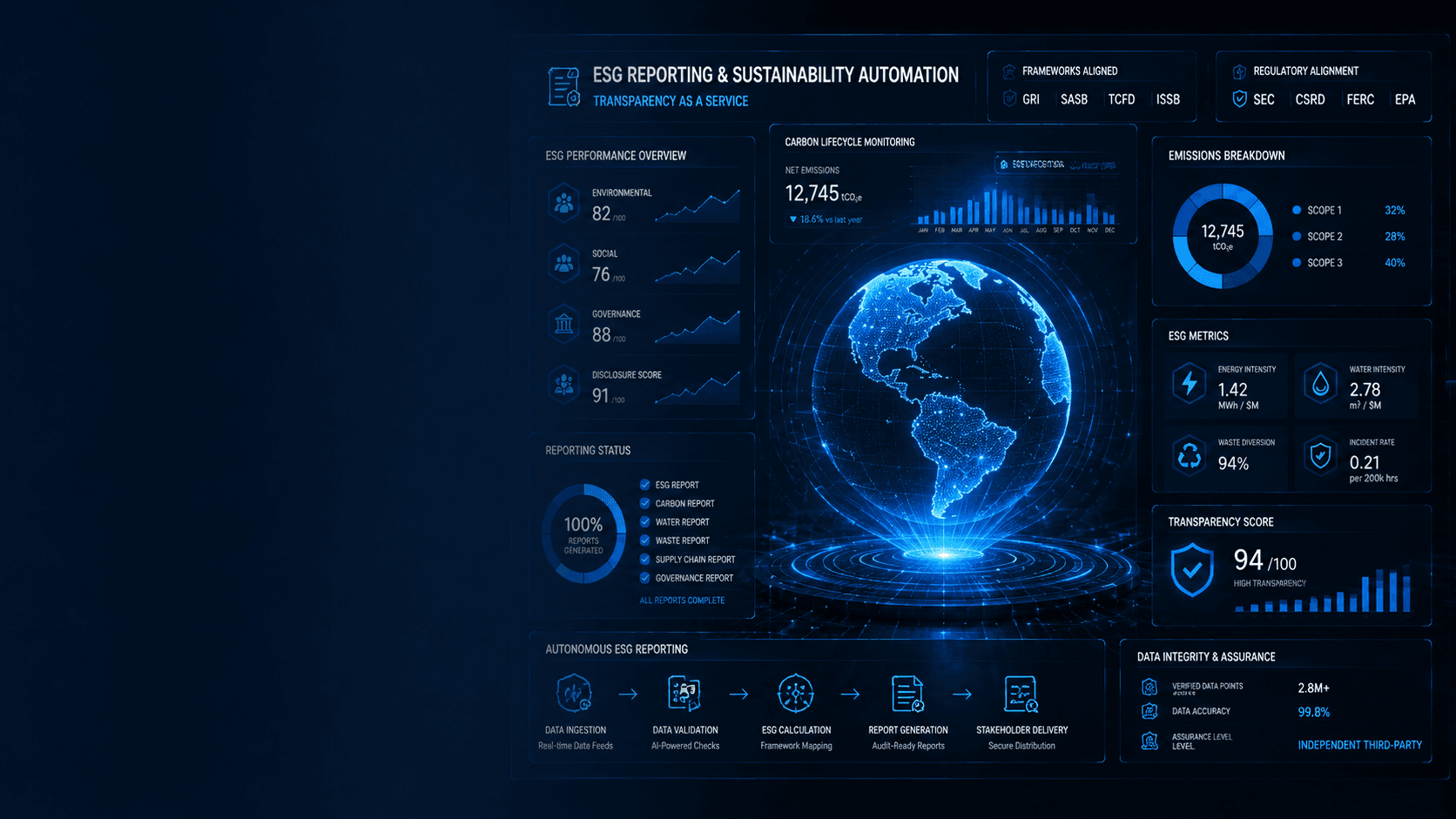
Technology Analysis
TURNING TECHNOLOGY SHIFTSINTO ENTERPRISESOFTWARE CAPABILITIES.
Prime Logic evaluates, structures, and documents the software architectures, data pipelines, and integration patterns required to build modern environmental and infrastructure platforms.

The PLS Competitive Advantage
From Technology Hype to Operational Readiness
Engineering teams need more than marketing buzzwords. They need systems that actually scale and integrate.
The Evaluation Problem
Technology choices are often driven by trends rather than operational reality, leaving teams with disjointed tools, isolated data lakes, and systems that fail to integrate properly.
The Architectural Solution
Prime Logic’s technology analysis focuses on practical systems engineering: data structures, API integrations, security controls, and long-term maintainability. The goal is to build resilient platforms.
The Implementation Gap
Selecting a technology stack is only the first step. The true challenge is mapping legacy workflows into modern, secure, cloud-native environments without losing operational continuity.
The Verification Standard
A valid technology stack must not only perform well but also provide immutable audit trails, high availability, and secure access controls that stand up to institutional scrutiny.
The PLS Competitive Advantage
What We Analyze and Structure
A practical engineering layer for architecture, integrations, and deployment decision-making.
System Architecture
Cloud deployment models, microservices, database structures, and high-availability design patterns.
API & Integrations
REST/GraphQL standards, SCADA connections, lab data imports, and legacy system bridges.
Data Governance
Data lakes, warehousing, access controls, retention policies, and encryption standards.
AI & Automation
Machine learning workflows, LLM integration boundaries, and automated data validation logic.
Security & Compliance
Zero-trust architectures, SSO/SAML, role-based access, and SOC 2 / ISO 27001 readiness.
Infrastructure as Code
CI/CD pipelines, containerization (Docker/K8s), automated testing, and deployment scripts.
System Observability
System monitoring, error tracking, performance logging, and uptime metrics.
Scalability Mandates
Handling massive telemetry data, multi-tenant SaaS isolation, and concurrent user spikes.
The PLS Competitive Advantage
Technology Domains
Organized around the technical capabilities required for modern enterprise systems.
Cloud Infrastructure
AWS/Azure/GCP deployment strategies and serverless architectures.
Data Engineering
ETL pipelines, data warehousing, and high-volume stream processing.
API & Integration Services
Secure webhook receivers, GraphQL layers, and third-party API syncing.
Spatial & GIS Systems
Geospatial indexing, vector tiles, and mapping engine integrations.
AI & Machine Learning
Anomaly detection models, predictive analytics, and LLM orchestration.
Security & Access Control
OAuth2, JWT authentication, and fine-grained authorization layers.
IoT & Telemetry
MQTT brokers, edge computing, and high-frequency sensor data ingestion.
Mobile Field Operations
Offline-first databases, sync resolution, and cross-platform app deployment.
Dashboard Architecture
Real-time WebSockets, state management, and charting optimization.
Reporting Engines
Automated PDF generation, Excel exports, and asynchronous report queues.
DevOps & CI/CD
GitHub Actions, Terraform, automated testing, and blue/green deployments.
System Auditing
Immutable log retention, compliance tracing, and event sourcing.
Featured Technology Analysis Briefs
Practical architectural notes for teams building enterprise environmental software.
The Water Utility SCADA Security Gap: Why ICS Networks Are Environmental Infrastructure's Biggest Risk
Industrial control systems managing critical water infrastructure remain dangerously exposed, with legacy OT protocols operating decades outside modern cybersecurity frameworks.
Digital Twin Hydraulics: How EPANET-AI Hybrids Are Redefining Pipe Failure Prediction
Coupling EPANET's hydraulic simulation engine with Graph Neural Network anomaly detection achieves sub-5% false-positive rates in pipe burst prediction — a tenfold improvement over legacy condition-scoring models.
PostGIS vs. Esri File Geodatabase: Spatial Database Selection for Enterprise Environmental GIS
A technical comparison of PostGIS 3.4 and Esri File Geodatabase across query performance, topology management, versioning, and multi-user concurrency for enterprise environmental GIS workflows managing millions of regulated feature records.
EPANET Hydraulic Model Cloud Migration: From Desktop Simulation to Real-Time API-Driven Inference
Containerizing EPANET 2.2 as a cloud-native microservice behind a REST API enables water utilities to shift from weekly batch simulation runs to continuous 15-minute hydraulic state estimation — a transformation that unlocks pressure zone optimization, leakage localization, and demand forecasting at operational timescales.
Environmental Data Pipeline Architecture: Ingestion, Validation, and Lineage for Regulatory-Grade Datasets
Designing environmental data pipelines that satisfy EPA data quality objectives, maintain chain-of-custody documentation for regulatory submissions, and scale to handle multi-petabyte satellite and sensor archives requires architectural patterns distinct from standard enterprise ETL infrastructure.
AI-Powered Environmental Permit Review: NLP Classification and Regulatory Logic Extraction at Scale
Large language models fine-tuned on EPA and state agency permit databases can classify permit application completeness, extract applicable regulatory standards, and flag potential compliance gaps at throughput rates 40x faster than manual review — but require careful prompt engineering to avoid hallucinated regulatory citations.
IoT Environmental Sensor Network Architecture: Edge Processing, MQTT Broker Design, and Data Quality Frameworks
Designing production IoT sensor networks for environmental monitoring requires edge computing architectures that apply sensor-specific QA algorithms locally before transmission, MQTT broker topologies that maintain data continuity under cellular network outages, and centralized data quality frameworks that enforce EPA DQO compliance across heterogeneous sensor types.
Carbon Accounting Software Architecture: From Emission Factor Libraries to Automated GHG Inventory Generation
Building a production carbon accounting system that maintains IPCC emission factor library version control, applies GHG Protocol Scope 1/2/3 calculation methodologies correctly across activity data categories, and generates auditable GHG inventories for CDP, SEC, and CSRD reporting requires architectural decisions most ESG software vendors have not yet solved.
Sentinel-1 InSAR for Critical Infrastructure Subsidence Monitoring: Operational Protocols and Detection Thresholds
Interferometric Synthetic Aperture Radar processing of Sentinel-1 time-series achieves millimetre-per-year subsidence detection rates for dams, levees, and water treatment facilities — providing continuous structural settlement monitoring at a fraction of the cost of traditional survey benchmarking programmes.
Ready to initialize?
Access your dedicated Intelligence Dashboard.
How Technology Analysis Becomes Software Architecture
Prime Logic translates technical requirements into deployable system components.
Define System Requirements
What operational challenge, data volume, or user workflow is the technology meant to solve?
Map Integration Points
What existing databases, external APIs, legacy systems, or hardware must be connected?
Design Data Architecture
How will the information be stored, queried, structured, and secured at scale?
Select Core Technologies
Which frameworks, cloud services, and open-source libraries are actually fit-for-purpose?
Build Security Controls
How is system access authenticated, authorized, logged, and continuously monitored?
Prototype the Pipeline
Validate the end-to-end data flow from field collection to dashboard visualization.
Automate Deployment
Establish CI/CD pipelines and infrastructure-as-code for reliable, repeatable system updates.
Monitor and Scale
Deploy observability tools to track system health, catch errors, and handle growing data volumes.
Systems That Depend on Solid Architecture
Technical understanding should shape the software foundation from the beginning.
Enterprise SaaS Platforms
Multi-tenant isolation, subscription handling, massive scale, and high-availability infrastructure.
Telemetry Dashboards
Real-time state processing, WebSockets, time-series databases, and low-latency rendering.
GIS Mapping Engines
Spatial indexing, vector tile servers, heavy asset rendering, and geospatial calculations.
High-Volume Data Lakes
Distributed storage, columnar databases, ETL pipelines, and complex analytical querying.
Mobile Inspection Apps
Offline-first synchronization, local database storage, conflict resolution, and battery optimization.
Automated Reporting Engines
Asynchronous task queues, heavy PDF generation, data aggregation, and delivery webhooks.
Ready to initialize?
Access your dedicated Intelligence Dashboard.
The PLS Competitive Advantage
Technology Analysis With Clear Boundaries
Architecture requires pragmatism. The best technology is the one that actually ships and survives.
Purpose of Analysis
Prime Logic’s Technology Analysis content is designed to support engineering planning, architectural decisions, and platform modernization efforts.
Professional Boundaries
It does not replace detailed, system-specific engineering design, proprietary vendor assessments, or internal security audits.
Implementation Reality
Architecture on paper must survive real-world constraints: legacy data, limited bandwidth, tight budgets, and human error in the field.
Security Precedence
System convenience and cutting-edge features must ultimately defer to institutional security policies and zero-trust mandates.
Technology Analysis Library
Architecture briefs, integration guides, data pipeline patterns, and cloud deployment references.
Architecture Briefs
Deep dives into system structures, microservices, and component design.
Integration Guides
How to connect APIs, SCADA systems, and legacy on-premise databases.
Data Pipeline Patterns
Strategies for moving, cleaning, and storing high-volume environmental data.
Security Checklists
Best practices for implementing zero-trust, RBAC, and data encryption.
Cloud Deployment Models
Comparisons of serverless, containerized, and dedicated hosting strategies.
AI Integration Strategies
Safely incorporating machine learning into enterprise compliance workflows.
DevOps Playbooks
Step-by-step guides for automating testing, building, and deploying software.
Database Design References
Frameworks for schema design, multi-tenancy, and time-series data storage.
Ready to initialize?
Access your dedicated Intelligence Dashboard.
NEXT STEPS
Need To Build A Resilient Software Architecture?
Prime Logic can help engineer data pipelines, cloud infrastructure, API integrations, and secure reporting workflows for your next platform.
MAKE A CONSULTATION
We Provide Best Advice
For Your Future
Get expert advice tailored to your needs. Book a consultation with our professionals to discuss your project and take the next steps toward success.
Write a Quick Mail
support@primelogicsol.com
Office Hours
Monday-Friday: 9:00 AM - 6:00 PM (EST)
Saturday: By Appointment Only
Corporate Headquarters
11166 Fairfax Blvd Ste 500, Fairfax, VA 22030
Secure Consultation Intake
- ⬤ Encrypted Communications
- ⬤ NDA-Friendly Discussions
- ⬤ U.S. Data Residency
- ⬤ Enterprise Security Standards
America First
Institutional Data Sovereignty
Book Your Consultation
Secure Institutional Discovery