
ESG Briefings
TURNING ESG FRAMEWORKSINTO ENTERPRISESOFTWARE CAPABILITIES.
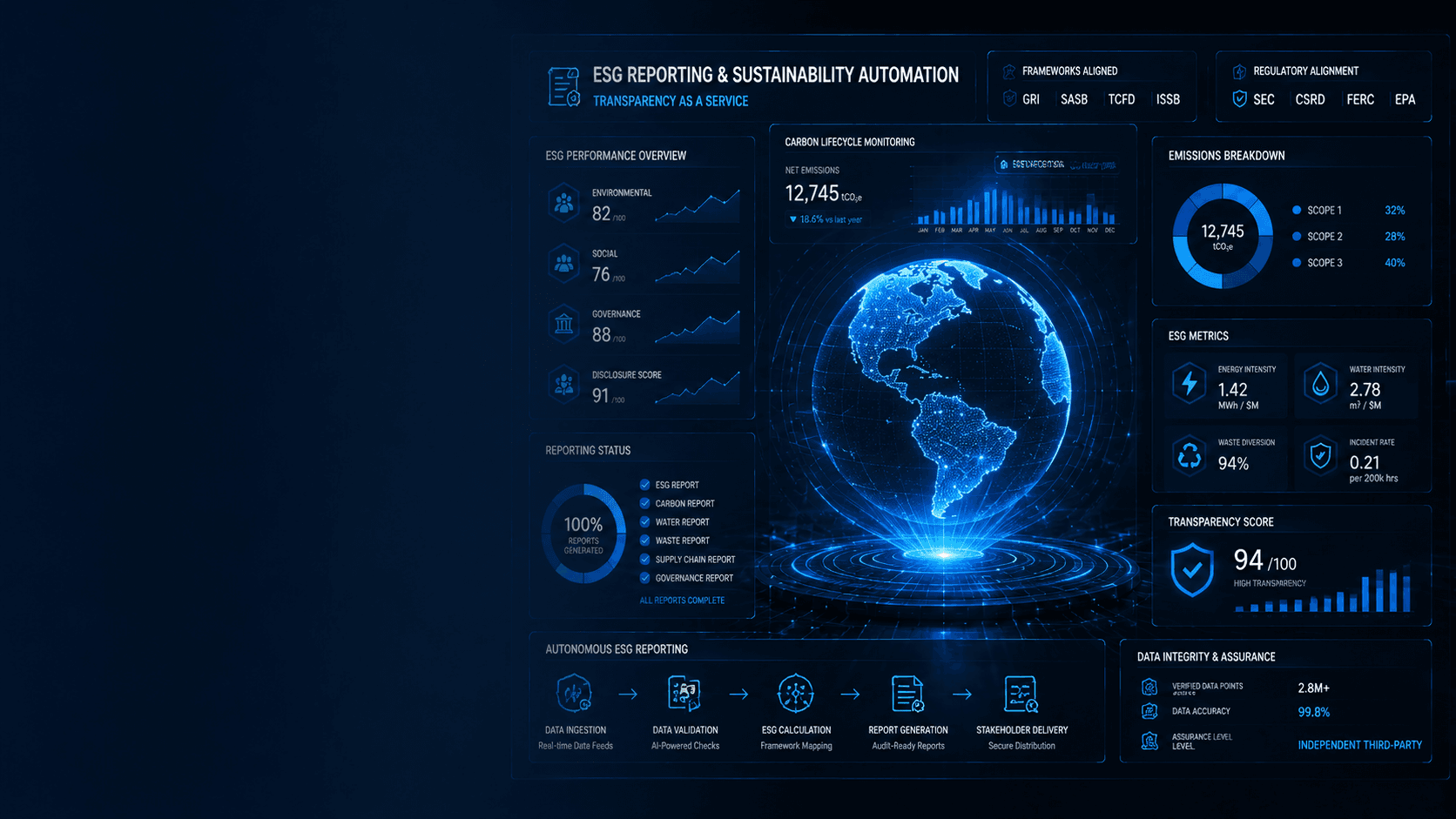
Prime Logic translates complex sustainability frameworks, global reporting standards, and climate risk mandates into structured data pipelines, automated reporting workflows, and audit-ready software architecture.

The PLS Competitive Advantage
From ESG Theory to Operational Readiness
Sustainability teams need more than spreadsheets. They need enterprise platforms that standardize disclosure.
The Data Collection Problem
ESG data is notoriously scattered across utility bills, scattered spreadsheets, legacy ERP systems, third-party suppliers, and disjointed departmental silos.
The Platform Solution
Prime Logic’s ESG approach focuses on centralizing this information into auditable software structures: emission factors, utility API integrations, survey workflows, and automated dashboards.
The Disclosure Gap
Calculating carbon is only half the battle. The true challenge lies in proving the methodology, retaining evidence, and generating compliant exports for CSRD, SEC, or ISSB.
The Assurance Standard
A valid ESG platform must provide immutable audit trails, workflow approvals, and transparent calculation logic that stands up to Big Four financial assurance requirements.
The PLS Competitive Advantage
What We Track and Structure
A practical intelligence layer for corporate sustainability, carbon accounting, and supply chain tracing.
Reporting Frameworks
CSRD, ISSB, SEC Climate Rules, GRI, and SASB disclosure requirement mapping.
Carbon Accounting
Scope 1, 2, and complex Scope 3 (Category 1-15) emission factor calculations.
Supply Chain Traceability
Supplier surveys, EUDR geospatial verification, and Scope 3 data aggregation.
Materiality Assessments
Double materiality scoring matrices, stakeholder surveys, and financial impact modelling.
Audit & Assurance
Evidence retention, calculation transparency, and workflow lock mechanisms for auditors.
Climate Risk Models
TCFD scenario analysis, physical risk mapping, and transition risk financial modelling.
Diversity & Governance
Board composition, pay gap analysis, human rights due diligence, and policy tracking.
Biodiversity & Water
TNFD spatial analysis, water stress tracking, and nature-positive commitment metrics.
The PLS Competitive Advantage
ESG Domains
Organized around the sustainability capabilities required for modern enterprise systems.
Scope 1 & 2 Emissions
Direct fuel consumption and purchased electricity data pipelines.
Scope 3 Value Chain
Purchased goods, business travel, and financed emission tracking.
Double Materiality
Impact and financial risk identification workflows for CSRD.
Supply Chain Due Diligence
Supplier verification and geospatial deforestation tracking (EUDR).
TCFD & Climate Risk
Physical and transition risk scenario modelling and financial impact.
Social & Labor Metrics
Workforce diversity, human rights, and occupational health data.
Water & Waste Data
Water withdrawal, circular economy metrics, and hazardous waste tracking.
Governance & Ethics
Board oversight, anti-corruption policies, and lobbying disclosures.
Taxonomy Alignment
EU Taxonomy CapEx/OpEx alignment and green revenue tracking.
Audit Readiness
Limited and reasonable assurance documentation trails.
Target Setting
SBTi net-zero trajectories and decarbonization pathway modelling.
Framework Mapping
Cross-referencing metrics between GRI, SASB, and ISSB standards.
Featured ESG Briefings
Practical intelligence for teams building sustainability and disclosure systems.
GHG Protocol Scope 3 Category 15: The Financial Sector's $847 Trillion Financed Emissions Problem
Category 15 financed emissions now represent the single largest untackled GHG accountability gap, forcing global financial institutions to re-evaluate portfolio exposure at unprecedented scale.
TCFD Implementation: The Four-Pillar Framework Every Board-Level Risk Committee Must Operationalize
TCFD-aligned disclosure is now mandatory for over 1,400 UK listed companies and financial institutions, incorporated into IFRS S2, and referenced in SEC climate rule guidance — making the four-pillar governance-strategy-risk management-metrics framework the universal architecture for climate risk disclosure regardless of voluntary or mandatory status.
SBTi Net-Zero Standard for Water Utilities: Setting Science-Based Targets Across Scope 1, 2, and 3
The Science Based Targets initiative's Net-Zero Standard requires water utilities to achieve 90–95% absolute emission reductions by no later than 2050, with interim near-term targets aligned to 1.5°C trajectories — a commitment that forces decarbonisation investment planning across energy procurement, fleet electrification, and wastewater treatment process redesign simultaneously.
GRI Standards 2021: The Shift to Impact Materiality and What It Means for Environmental Disclosure
GRI's 2021 Universal Standards revision replaced the traditional 'financial materiality' concept with 'impact materiality' — requiring organizations to identify and disclose their actual and potential negative impacts on the environment and society regardless of financial consequence to the reporting entity.
TNFD Beta Framework: Nature-Related Financial Disclosures and Biodiversity Risk Quantification
The Taskforce on Nature-related Financial Disclosures' September 2023 final recommendations introduce LEAP (Locate, Evaluate, Assess, Prepare) as the nature risk assessment process underpinning disclosure, requiring organizations to geolocate operations and supply chains relative to biodiversity-sensitive areas using IBAT, ENCORE, and Global Biodiversity Framework target metrics.
CDP Water Security Program: Scoring Methodology and What AA-Grade Disclosure Actually Requires
CDP's Water Security questionnaire scores 4,000+ corporate disclosures across awareness, management, and leadership dimensions — but achieving Leadership band (A or A-) requires quantitative basin-level water stress assessment, supplier engagement on water, and board-level water governance documentation that most corporate sustainability functions are unprepared to provide.
ISSB IFRS S1 and S2: The Global Baseline for Sustainability and Climate-Related Financial Disclosures
The ISSB's IFRS S1 (general sustainability disclosures) and IFRS S2 (climate-specific disclosures) establish the first globally consistent mandatory baseline for sustainability reporting, adopted or referenced by regulators in jurisdictions representing 55% of global GDP as of June 2024.
EU Sustainable Finance Taxonomy: Technical Screening Criteria for Environmental Objectives 1-6
The EU Taxonomy's six environmental objectives are now operationalized through Technical Screening Criteria in two Delegated Acts covering 200+ economic activities — requiring companies to apply activity-level criteria, DNSH assessments across all six objectives, and minimum social safeguard verification for every reported Taxonomy-eligible revenue line.
Corporate Biodiversity Footprint: ENCORE, LEAP, and the Emerging Methodology Stack for Nature Accounting
Three distinct methodological approaches — ENCORE for dependency/impact screening, LEAP for geospatial risk assessment, and Global Biodiversity Score for footprint quantification — are converging into an emerging corporate nature accounting standard as TNFD adoption accelerates and EU CSRD requires biodiversity disclosure under ESRS E4.
Ready to initialize?
Access your dedicated Intelligence Dashboard.
How ESG Requirements Become Software Architecture
Prime Logic translates sustainability mandates into deployable system components.
Define Disclosure Mandates
Which frameworks (CSRD, SEC, ISSB) and jurisdictions apply to the organization?
Map Materiality
Which ESG topics are financially material or have significant environmental impacts?
Design Data Architecture
How will utility data, ERP exports, and supplier surveys be ingested and standardized?
Build Calculation Engines
Which emission factor databases (EPA, DEFRA, Ecoinvent) will power the conversions?
Implement Workflow Controls
How is data reviewed, approved, and locked prior to final disclosure generation?
Generate Audit Trails
Can every final metric be traced back to its raw source document and calculation method?
Automate Reporting Exports
How can the system generate XBRL tags or formatted PDF disclosures for regulators?
Monitor Target Trajectories
Track actual performance against SBTi net-zero commitments and baseline years.
Systems That Depend on ESG Intelligence
Sustainability understanding should shape the software foundation from the beginning.
Carbon Accounting Engines
Emission factor mapping, utility API integrations, and multi-region conversion logic.
CSRD Disclosure Portals
ESRS topic mapping, double materiality workflows, and narrative generation.
Supply Chain Traceability
Supplier scorecards, automated risk flagging, and EUDR geospatial verification.
ESG Data Lakes
Centralized repositories for HR metrics, procurement data, and environmental telemetry.
Audit & Assurance Platforms
Evidence attachment, version control, role-based locking, and auditor portals.
Decarbonization Dashboards
CapEx planning, marginal abatement cost curves, and trajectory tracking.
Ready to initialize?
Access your dedicated Intelligence Dashboard.
The PLS Competitive Advantage
ESG Analysis With Clear Boundaries
Software provides the structure, but human expertise provides the strategy.
Purpose of Analysis
Prime Logic’s ESG content is designed to support data architecture, workflow automation, and reporting readiness.
Professional Boundaries
It does not replace specialized legal counsel, certified financial auditing, or proprietary climate risk science.
Data Interpretation
Software systems calculate based on provided inputs and emission factors. They organize information but require human validation for strategic decisions.
Assurance Precedence
System outputs must ultimately be reviewed and verified by independent third-party assurance providers prior to public disclosure.
ESG Briefings Library
Framework implementation guides, carbon accounting patterns, and disclosure references.
Framework Implementation Guides
Step-by-step technical mapping for CSRD, SEC, and ISSB standards.
Carbon Accounting Patterns
Data pipeline architectures for complex Scope 3 calculations.
Double Materiality Workflows
Best practices for digitizing stakeholder surveys and risk matrices.
Supply Chain Checklists
Strategies for integrating supplier data into central ESG data lakes.
Audit Readiness Strategies
How to structure software controls for limited and reasonable assurance.
Taxonomy Alignment Models
Financial tagging structures for green revenue and CapEx/OpEx.
Biodiversity Data Strategies
Incorporating spatial and ecological data into corporate disclosures.
ESG Integration Playbooks
How to connect ERP, HRIS, and utility systems via automated APIs.
Ready to initialize?
Access your dedicated Intelligence Dashboard.
NEXT STEPS
Need To Turn ESG Complexity Into A System?
Prime Logic can help structure sustainability metrics, reporting workflows, supply chain data, and carbon accounting into practical software architecture.
MAKE A CONSULTATION
We Provide Best Advice
For Your Future
Get expert advice tailored to your needs. Book a consultation with our professionals to discuss your project and take the next steps toward success.
Write a Quick Mail
support@primelogicsol.com
Office Hours
Monday-Friday: 9:00 AM - 6:00 PM (EST)
Saturday: By Appointment Only
Corporate Headquarters
11166 Fairfax Blvd Ste 500, Fairfax, VA 22030
Secure Consultation Intake
- ⬤ Encrypted Communications
- ⬤ NDA-Friendly Discussions
- ⬤ U.S. Data Residency
- ⬤ Enterprise Security Standards
America First
Institutional Data Sovereignty
Book Your Consultation
Secure Institutional Discovery